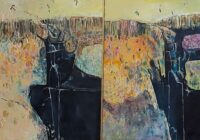
I made a gelli plate from an online recipe a while ago, sometime before October 2024 (see this piece made with the outputs). It went mouldy, really badly mouldy, creepy mouldy.
I had bought more glycerine and gelatine than i needed (because it was cheaper to buy a litre than 2 x 250ml bottles). I finally used up the remainder of that this week and re moulded, this time adding isopropyl alcohol so it won’t go mouldy.
I made them in circular decor containers and a few square ones – last time I made an A3 sized one, but i was interested in playing with image transfer and it seems based on the insta videos i’ve seen, that you need to let the layers dry, so I thought this time I’d be better of with a few smaller ones so i can work (as I like to) on multiple pieces as they dry.
I was hopeful for the small metal biscuit tin, but couldn’t get the gelli mould out without breaking. similarly the square one didn’t wanna come out of its world. Then the square one broke in two.
Fortunately with gelli moulds you can cut them up, put them in the microwave and re mould them (there are a few flecks of red paint in the new one, but i will call that serendipity).
I played with some acrylics I bought when i was working on the Sydney Harbour series. Bright, opaque, cheap. But it puts the focus not on mixing the colour i want but working out how the moulds work best.
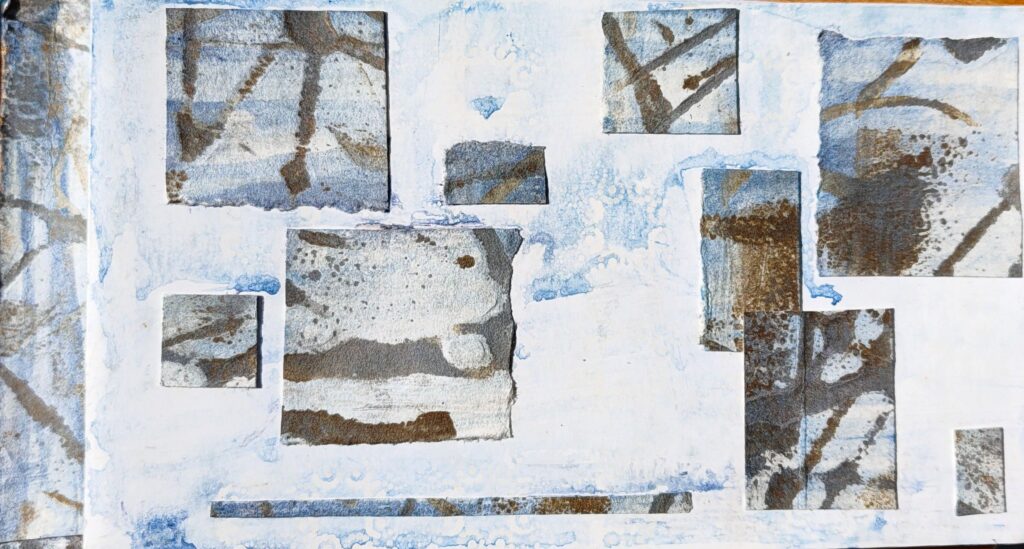
I took templates I already had with words and shapes on them, and layered them wet using a brayer. Put them onto some old sheet music from my piano days. I have so much sheet music, some of it from the 1930s and 1940s. I know that they will only survive with a truckload of lacquer over the top (my experience with a 100 year old book found in a back yard dumpster in Chicago way back in 2016 taught me that – the stuff just disintegrates – see Caillebotte’s Rainy Paris Street and Georges Seurat’s Sunday in the Park), but it would be fine for something I could later collage into a piece.
Anyway what I learnt:
- layers are fine, keep the acrylic wet
- all the vids I watched had a final base layer, but if the background is a layer (e.g. sheet music), then you don’t need one).
- brayers are fabulous.
I ended up reformatting the moulds and now have a different set of squares and circles. next I want to try with maybe an etched print and see what happens. It may not work but it is lovely – the physical sensation of the rounded moulds as I push on them is great.